The app
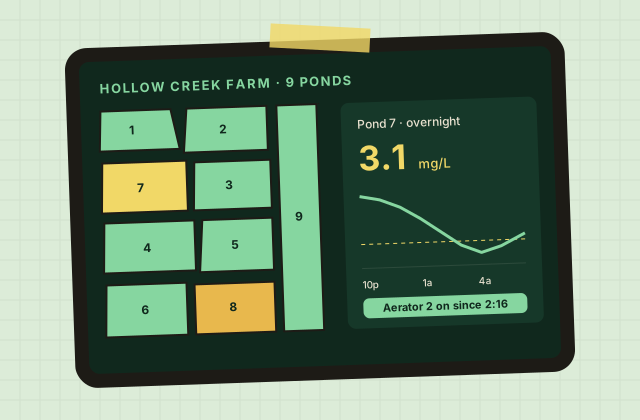
iOS and Android, React Native. Night mode from sunset, alarms that break through Do Not Disturb, and a farm map for the morning.
Two founders in Stuttgart, Arkansas, had a pond sensor that worked and an app that farmers ignored. In 14 weeks we rebuilt the app around one moment, the night alarm, and launched it through the feed stores farmers already trust.
01 / The problem
Catfish ponds lose oxygen fastest between midnight and dawn. When it drops below about 3 mg/L, a farm can lose a pond of fish in an hour. Brineworks’ sensor caught the drop. Their first app showed it on page three of a dashboard built for daytime, on a laptop.
Farm managers told us the same thing in different words: at 2 a.m., in a truck, with gloves on, they need one number, one color and one button. Everything else could wait for breakfast.
“If I have to log in, the fish are already dead.” — a farm manager, week 1
02 / From sketch to shipped
Drag the handle to compare the sketch we tested with six farm managers against the screen that shipped. The layout barely moved; the type got bigger and the button got louder.
03 / What shipped
iOS and Android, React Native. Night mode from sunset, alarms that break through Do Not Disturb, and a farm map for the morning.
Takes a reading from every sensor each minute, spots a falling trend 25 minutes early and pages the right person, then the next one.
A counter card, a setup video and a 20-minute training so feed store staff could install sensors and sign farms up on the spot.
04 / Timeline
05 / Results
“They sat in a pond truck with us at two in the morning. The alarm screen came straight out of that night, and so did our Series A story.”
Leilani Treadway
Cofounder and CEO, Brineworks · with Dmitri Gentry, cofounder and CTO